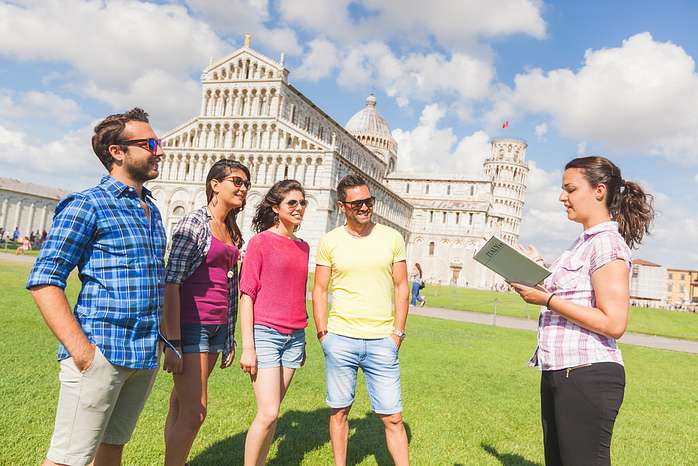


Giada was a superb guide for a first timer to Pisa. Her gift of storytelling and command of facts both engaged and enriched the experience. This was enhanced by her easy disposition and bubbly personality.

1
Experience available
Pisa Tours
Expert-led Pisa guided tours that turn medieval power and architectural wonders into meaningful discoveries
Let Your Curiosity Shape Your Journey
Join passionate experts on intimate walking tours that reveal a city's unique stories, spark conversations, and leave you seeing the world—and yourself—a little differently.

Crafted for conversation
With ten or fewer guests, ask questions, engage with your Expert, and fully immerse yourself.
Experts, not guides
Explore with 1,200+ Experts, from historians and architects to archaeologists and chefs.
Structured, never scripted
Your interests guide your Expert, leading to stories and perspectives that matter to you.
From curious to connoisseur
For first-time visitors or seasoned explorers, our tours span city highlights to deep-dive masterclasses.
Pisa, Seen with Context
Pisa isn’t only its famous leaning tower. Walk with an expert to explore how maritime power, scholars, and medieval ambition shaped this historic city.
Hear from our customers
Excellent tour! Giana was a great guide who was very knowledgeable about everything we saw. She went out of her way to make sure we were taken care of!!
Grazie mil for the tour. We REALLY enjoyed all the details that gave us a flavor of the times & history. Gaston Francini had a wealth of details and kept it interesting & invigorating. He also had great recommendations for restaurants ( including a Gluten-free option).
Pisa Tours
Pisa lies along the Arno River in western Tuscany, a short distance from the Tyrrhenian Sea. During the Middle Ages, the city rose to prominence as one of Italy’s powerful maritime republics, controlling trade routes across the Mediterranean and developing significant wealth through commerce and naval power. Much of Pisa’s architectural legacy dates from this period, when the city invested heavily in monumental churches and civic buildings that symbolized its influence.
Today, Pisa is best known for the Leaning Tower, yet the city’s historic center and religious complex reveal a deeper story of medieval ambition, scientific discovery, and regional identity. The Piazza dei Miracoli, with its cathedral, baptistery, and tower, reflects the artistic achievements of medieval Tuscany. Context Travel’s Pisa tours are led by historians and cultural experts who help travelers understand how Pisa’s maritime power, architecture, and intellectual history shaped one of Italy’s most recognizable landmarks.
Pisa is known for its Leaning Tower, medieval architecture, and its historic role as a maritime republic.
The Leaning Tower of Pisa
Originally constructed as the bell tower of Pisa’s cathedral, the tower began to tilt during construction in the 12th century due to unstable soil, becoming one of the world’s most famous architectural landmarks.
Piazza dei Miracoli (Square of Miracles)
This UNESCO World Heritage site includes the cathedral, baptistery, and Leaning Tower, representing some of the finest examples of Romanesque architecture in Italy.
Pisa as a Maritime Republic
During the Middle Ages, Pisa controlled trade routes across the Mediterranean and rivaled cities such as Genoa and Venice in naval power.
Scientific Heritage and Galileo
Pisa is the birthplace of Galileo Galilei, whose experiments and observations helped transform the scientific understanding of physics and astronomy.
Tuscan Culture and Architecture
Beyond the Piazza dei Miracoli, Pisa’s historic streets, churches, and riverfront reflect the broader traditions of Tuscany.
Pisa appeals to travelers interested in architecture, medieval history, and scientific heritage. First-time visitors often begin with guided introductions to the Piazza dei Miracoli to understand the history and engineering behind the Leaning Tower and surrounding monuments. Lifelong learners appreciate deeper discussions about Pisa’s maritime republic and intellectual traditions, while travelers exploring Tuscany often include Pisa as part of a broader regional itinerary.
Pisa’s historic center is compact and easily explored on foot. Guided tours are one of the best ways to understand the city’s monuments and medieval history.
Many travelers visit Pisa on a half-day or day trip from Florence or Lucca, though spending a full day allows time to explore beyond the Piazza dei Miracoli.
Italian is the primary language spoken in Pisa, though English is widely spoken in tourism areas. Italy uses the euro (€) as its currency.
Spring and autumn offer particularly comfortable weather for exploring Pisa’s historic sites.
What is Pisa known for?
Pisa is best known for the Leaning Tower of Pisa and the medieval monuments of the Piazza dei Miracoli.
Is Pisa worth visiting?
Yes. Pisa offers remarkable medieval architecture, scientific heritage, and one of the most recognizable landmarks in the world.
How many hours do you need in Pisa?
Many travelers spend three to four hours visiting the Leaning Tower and surrounding monuments, though a full day allows time to explore the historic center.
Can you climb the Leaning Tower of Pisa?
Yes. Visitors can climb the tower with a timed ticket to experience its unique tilt and views over the city.
Is Pisa walkable?
Yes. Pisa’s historic center and major monuments are easily accessible on foot.
Is Pisa safe for travelers?
Pisa is generally considered safe for visitors, particularly around the historic center and major landmarks.